 productdif.com
 Modular design in hardware allows for easier upgrades, repairs, and customization by dividing a system into interchangeable components. Monolithic design integrates all functions into a single unit, often resulting in better performance but limited flexibility. Choosing between these approaches depends on priorities such as scalability, maintenance, and cost efficiency.
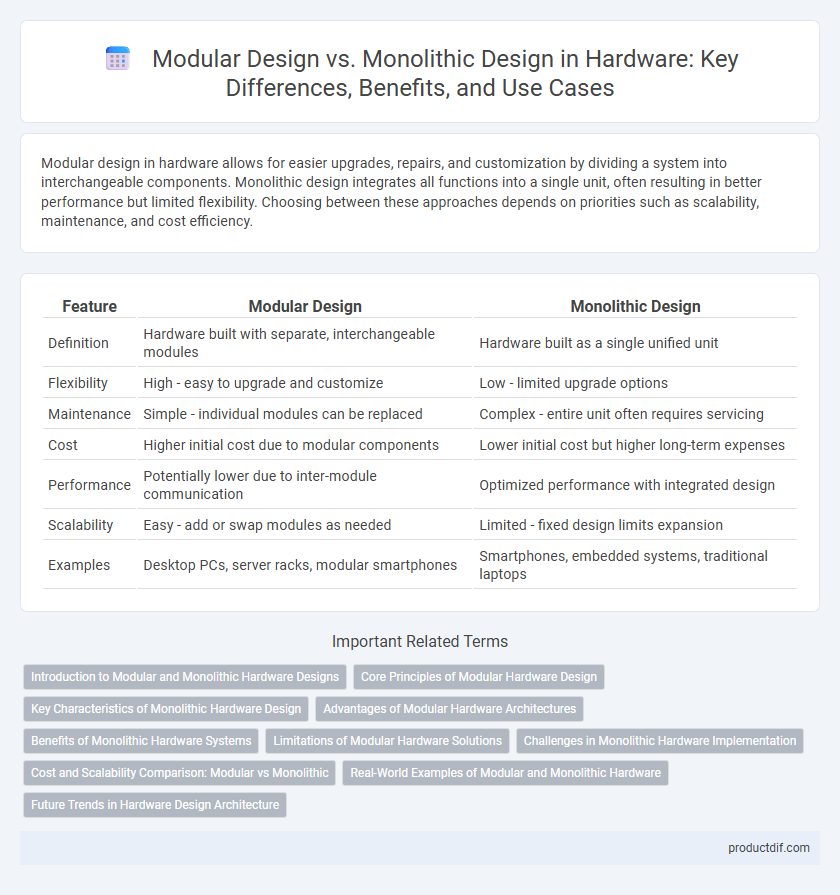
Table of Comparison
| Feature | Modular Design | Monolithic Design |
|---|---|---|
| Definition | Hardware built with separate, interchangeable modules | Hardware built as a single unified unit |
| Flexibility | High - easy to upgrade and customize | Low - limited upgrade options |
| Maintenance | Simple - individual modules can be replaced | Complex - entire unit often requires servicing |
| Cost | Higher initial cost due to modular components | Lower initial cost but higher long-term expenses |
| Performance | Potentially lower due to inter-module communication | Optimized performance with integrated design |
| Scalability | Easy - add or swap modules as needed | Limited - fixed design limits expansion |
| Examples | Desktop PCs, server racks, modular smartphones | Smartphones, embedded systems, traditional laptops |
Introduction to Modular and Monolithic Hardware Designs
Modular hardware design divides complex systems into smaller, interchangeable units, enhancing flexibility, scalability, and ease of maintenance. Monolithic hardware design integrates all components into a single, cohesive unit, often resulting in optimized performance and reduced latency. Understanding these foundational design approaches is crucial for selecting appropriate hardware architecture based on project requirements and resource constraints.
Core Principles of Modular Hardware Design
Modular hardware design centers on breaking down systems into independent, reusable components that simplify maintenance and upgrades. Each module operates as a self-contained unit with standardized interfaces, enabling flexible integration and scalability. This approach contrasts with monolithic designs by prioritizing isolation of functions, ease of troubleshooting, and adaptability in evolving hardware environments.
Key Characteristics of Monolithic Hardware Design
Monolithic hardware design features a single, unified architecture where all components are tightly integrated on one chip or board, resulting in high performance and low latency. This design typically offers enhanced reliability due to fewer interconnections and streamlined signal paths, but it lacks scalability and flexibility compared to modular alternatives. Manufacturing costs can be higher initially, with limited upgrade options once deployed.
Advantages of Modular Hardware Architectures
Modular hardware architectures offer enhanced flexibility by enabling easy upgrades and component replacements, reducing downtime and maintenance costs. They improve scalability, allowing systems to expand or adjust based on specific requirements without redesigning the entire hardware. Furthermore, modular designs promote fault isolation, leading to increased reliability and simplified troubleshooting processes.
Benefits of Monolithic Hardware Systems
Monolithic hardware systems offer improved reliability due to their integrated architecture, reducing points of failure compared to modular designs. They typically provide better performance by minimizing inter-component communication delays and optimizing data pathways. Enhanced cost efficiency arises from simplified manufacturing processes and lower material requirements in monolithic hardware systems.
Limitations of Modular Hardware Solutions
Modular hardware solutions often face limitations such as increased latency and reduced performance due to inter-module communication overhead. Compatibility issues arise from diverse module standards, complicating integration and scalability. Maintenance and troubleshooting can become more complex as system complexity grows, impacting overall reliability and cost-efficiency.
Challenges in Monolithic Hardware Implementation
Monolithic hardware design faces significant challenges such as limited scalability, increased complexity in troubleshooting, and difficulties in upgrading or replacing individual components. Its tightly integrated structure often leads to higher manufacturing costs and longer development cycles compared to modular alternatives. Performance bottlenecks and heat dissipation issues are common due to the concentrated nature of monolithic systems.
Cost and Scalability Comparison: Modular vs Monolithic
Modular design offers lower upfront costs due to its component-based architecture, enabling incremental upgrades and reducing waste, whereas monolithic design incurs higher initial investment with limited flexibility. Scalability in modular systems excels as individual modules can be added or replaced without extensive rework, contrasting with monolithic structures that require full-system modifications for expansion. This adaptability makes modular design more cost-effective and scalable over time, particularly in dynamic hardware environments.
Real-World Examples of Modular and Monolithic Hardware
Modular design is exemplified by desktop PCs, where components like GPUs, RAM, and storage can be independently upgraded or replaced, enhancing flexibility and repairability. In contrast, monolithic designs are seen in devices like smartphones and laptops, where integrated circuits and soldered components limit user modifications and repair options. Servers often employ modular architectures with hot-swappable power supplies and storage drives to ensure uptime and ease of maintenance, unlike monolithic embedded systems optimized for compactness and specific functionality.
Future Trends in Hardware Design Architecture
Modular design in hardware architecture enables scalable and easily upgradable systems by integrating standardized, interchangeable components, fostering rapid innovation and reducing time-to-market for new technologies. Monolithic design, while offering high performance through tightly integrated circuits, faces limitations in flexibility and adaptability to evolving user demands and technological advancements. Emerging trends emphasize hybrid architectures combining the efficiency of monolithic blocks with the adaptability of modular elements to optimize power consumption, processing speed, and support for AI-driven applications.
Modular Design vs Monolithic Design Infographic